Table of Contents |

What Do You See?
Let’s begin today’s lesson with a quick glance at these sets of images. What do they remind you of?

Each image is a minimal arrangement of color blocks and geometric curves. No text, no logos, no slogans. And yet I suspect for many of us especially in the U.S., they evoke something instantly recognizable.
If a brand or product comes to mind, you're already encountering one of the most powerful mechanisms in modern advertising: associative branding. This is advertising stripped to its bare ritual function.[1] Rather than persuading us through spoken or written words and "rational" appeal, they operate by cultivating emotional resonance, by embedding themselves in our shared memory structures.
This is the rhetorical power of ritualizing brand familiarity and distinction with repetition, and it sets the stage for our exploration of advertising as both a cultural artifact and an increasingly computational rhetorical craft.
Historical "Thickness" of Advertising
The history of advertising is deeply entangled with the evolution of media technology. From those street cries and painted signage of antiquity to the immersive digital campaigns of today, advertisements have always adapted to the dominant modes of public communication.
The Industrial Revolution marked a pivotal turning point, giving rise to professional advertising agencies that systematized commercial persuasion on a mass scale.[2] But the rapid proliferation of false and misleading ads during the late 19th and early 20th century led to public outcry and the eventual creation of government oversight bodies tasked with regulating commercial speech across emerging communication infrastructures, including what would become the Federal Communications Commission (FCC).[3]
In the 21st century, we’ve seen the decline of legacy ad agencies and the rise of platform-based digital advertising, as evidenced by the following chart showing tech giants like Google and Meta turning user data into a significant share of the U.S. economy through targeted ad revenue.
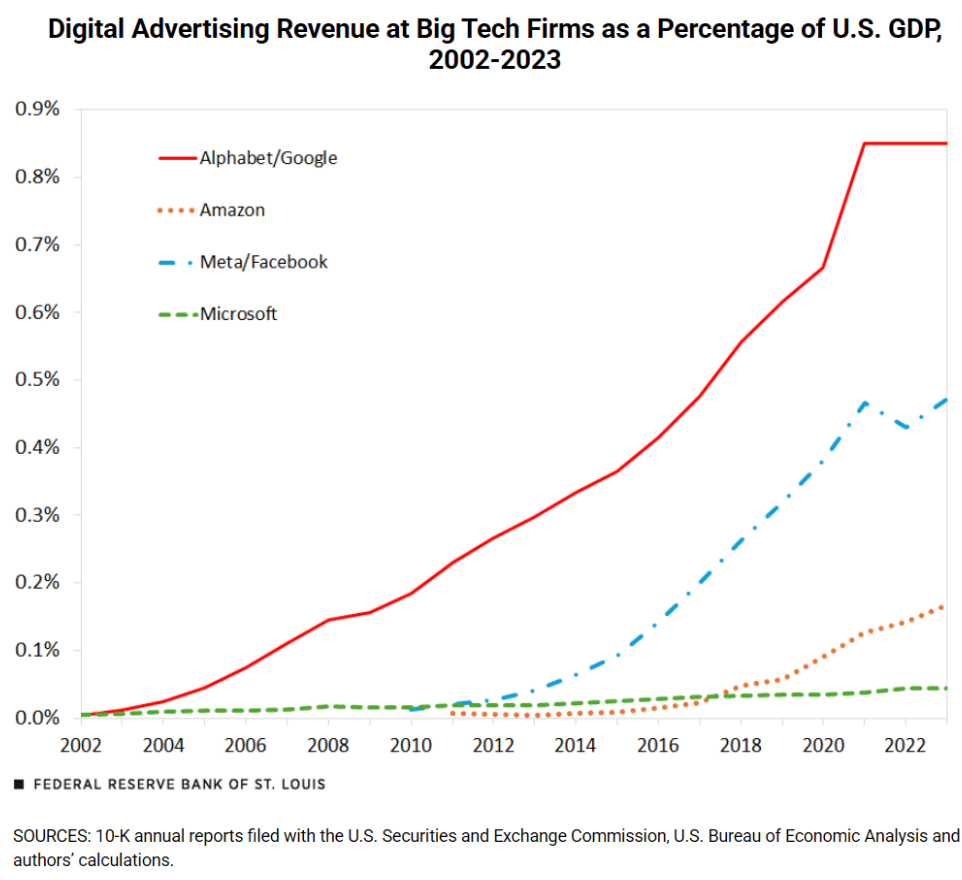
This transformation coincides with the rise of associative ads (which rely on emotional cues and brand mythologies) over older demonstrative strategies that emphasized product features and unique benefits. Altogether, these shifts mark a sweeping turn toward hyper-personalization and computational rhetoric, where machine learning systems continuously analyze behavioral data to generate ads optimized for each viewer’s psychological profile in real time.
Demonstrative and Associative Ads
Modern advertising increasingly drifts away from product demonstration and toward affective association. Let’s first pause briefly to clarify these two advertising modalities, by comparison the following two sets of advertisements:
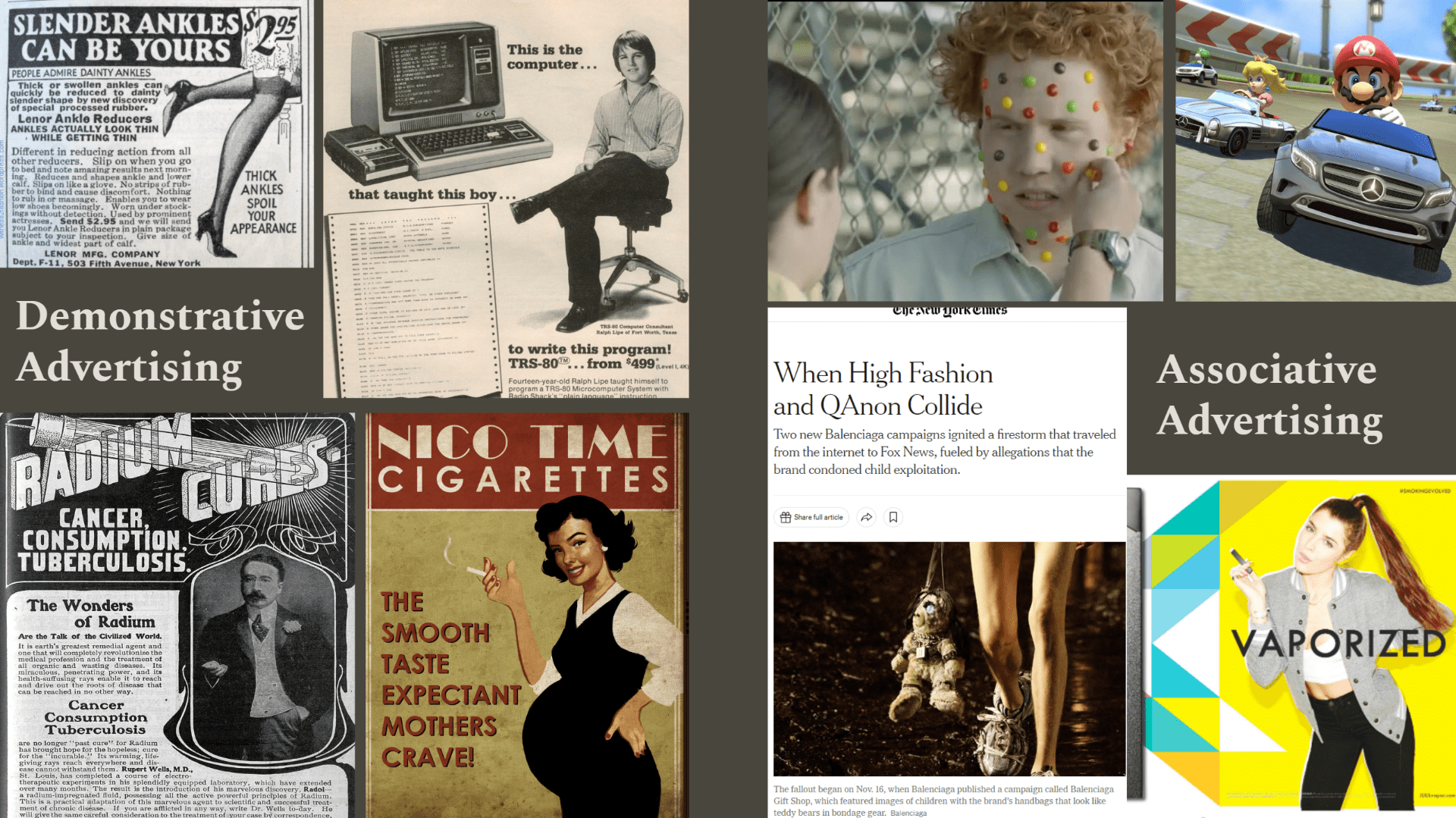
The left-side collage shows examples of demonstrative ads focused on highlighting features and demonstrating its unique benefits. Demonstrative advertising operates through propositional logic: “Here’s the product, here’s what it does better than the rest.”
Whereas in the collage on the right shows examples of associative ads, which rely on tapping into the audience's psychological structures to establish affective associations—what we might colloquially describe as "vibes," "moods," or "taste."[4]
Associative advertising embed brand recognition in a dense network of cultural signifiers, emotions, and memory triggers. This is a defining characteristic of contemporary advertising aesthetics: it is increasingly common to see advertisements that rely on abstract, subtle psychological cues to reinforce positive emotional associations with the brand:
Consider Doritos’ 2021 “Brandless” campaign: they removed their logo entirely, relying instead on the consumer’s internalized memory structure to make the identification.

Even non-visual cues can activate these memory structures. Intel’s iconic five-note chime [listen], for example, invokes a brand through auditory ritual repetitions.In these instances of associative advertising, the brand becomes what Roland Barthes calls a "mythic signifier," or a totemic object which what it symbolizes displaces what it actually sells.[5]
Ritual, Repetition, & Consumer Psychology
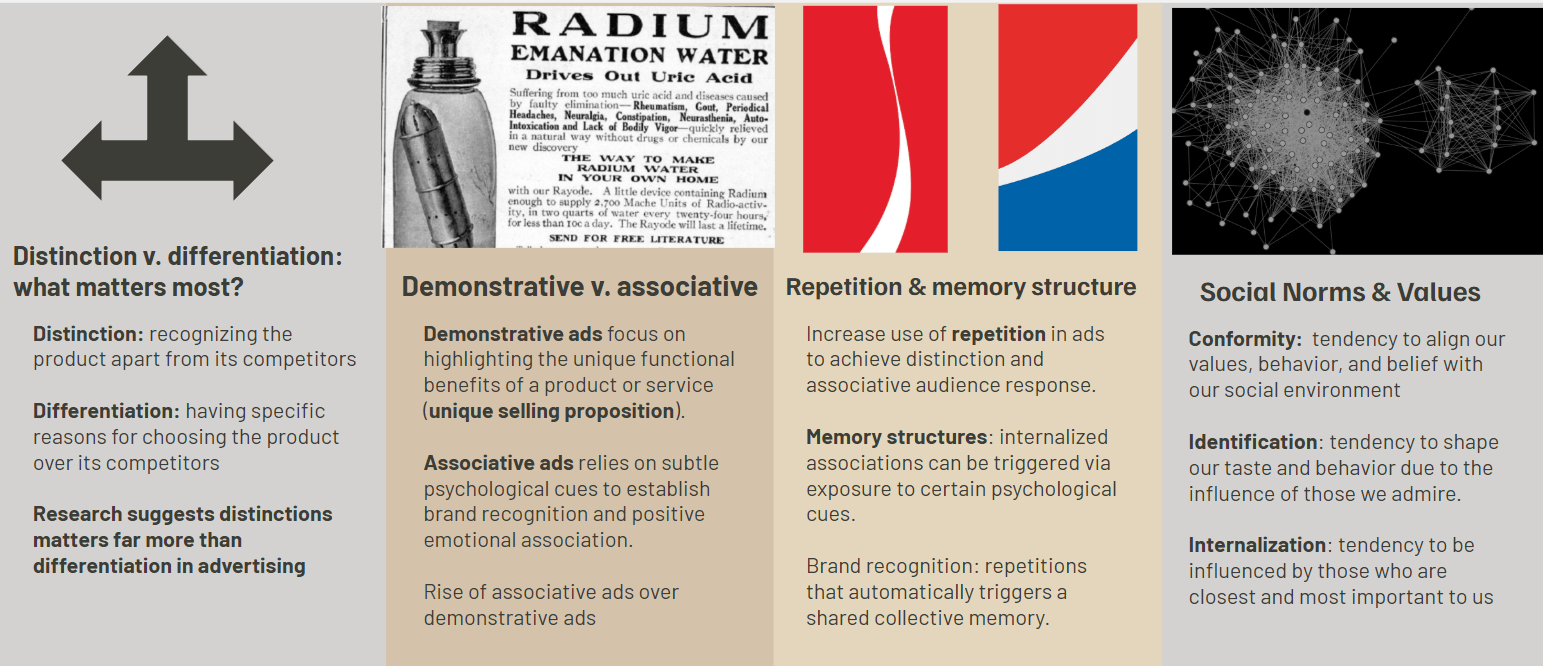
Thus, to study advertising is to study consumer psychology. In advertising theory, we often distinguish between differentiation and distinction:[6]
Differentiation answers the question: Why should I choose this product over others?Distinction answers the more basic question: How do I even recognize this product at all?
Media research increasingly shows that distinction, not differentiation, tends to be the more powerful persuasive force in shaping consumer behavior. That’s why brands invest so heavily in repetition: not just to inform, but to ritualize, because being recognized in its symbolic form tends to matter more than being better in its material substance.[7]
This also explains why associative ads often outperform their demonstrative counterparts in building long-term brand recognition. They become mnemonic devices that are triggered by repetitions of a color, a shape, a sound, a smell and so on. <Ayaz, Shaukat, Wisal Ahmad, and Mehboob ur Rashid. "Investigating the Comparative Effectiveness of Demonstrative and Straight-Sell Comparative Advertisements." The Journal of Humanities & Social Sciences 26, no. 1 (2018): 103-118.>
Perhaps most importantly, advertising persuades by triangulating the audience through structures of social influence, drawing on matrices of collective norms and values.
It taps into powerful psychological tendencies of conformity (aligning our behavior with perceived group expectations), identification (shaping our tastes based on those we admire), and internalization (adopting preferences rooted in close or emotionally significant relations). This is why the most effective ad campaigns often don’t feel like forceful persuasion at all. Instead, they invoke or manufacture a sense of belonging.[8]
Bandwagon & Anti-Bandwagon Effects
One of the most familiar tools in the advertiser’s kit is the Bandwagon effect, a widely observed tendency for an individual or groups of individuals to adopt behaviors or beliefs because “everyone else is doing it.”[9] Social media further amplifies this phenomenon, making virality itself a potent rhetorical resource.[10]
That said, a thing can turn into its opposite if pushed too far. Once a bandwagon becomes suffocating ubiquity, psychological reactance may kick in, and consumers would forcefully resist what feels like coercive overexposure. This phenomenon, known as the anti-bandwagon effect, can be understood as a psychological defense: a way of reclaiming personal autonomy and rhetorical agency by rejecting the overdetermination of peer pressure.[11]
Advertisers have harnessed the resistance potential of anti-bandwagon effect as well. Apple’s famous “1984” campaign did exactly that: it sold its Macintosh computers not as the dominant product, but as a manufactured revolt against the implied market domination of IBM at the time.[12]

Thus, whether through forced conformity or rebellion, modern advertising finds its way to exploit our desire to differentiate ourselves.
Social Marketing & Exploitation
Many companies now frame their messaging within narratives of social responsibility. This is called social marketing, where ads seek to advance not just sales by harnessing the narratives of civic virtues and the "common good."[13]
As we’ve seen in the case of Hershey’s 2021 “Accountability, Transparency, Due Diligence” campaign, which served as a rhetorical camouflage precisely at a moment when Hershey's was under investigation for child labor violations and facing a class action lawsuit filed by former child slaves who alleged that the Pennsylvania-based company "aided and abetted their enslavement on cocoa plantations in Ivory Coast."[14]

Another common form of advertising spin, known as "greenwashing," specifically involves the use of “green” language to sanitize a corporation’s image and distract from its environmental infractions.
Many critics point to the “Climate Change Collection” shown below as an example of IKEA’s social marketing campaigns to "greenwash" the company’s well-documented history of selling furniture made from illegally logged wood.[15]

These "spin" practices demonstrate that advertising is far more than just another marketing tool. It is deeply enmeshed in questions of citizenship practice, legitimacy, power, and exploitation.
Speaking of exploitation, perhaps few audiences are more vulnerable to ethically fraught advertising strategies than children.
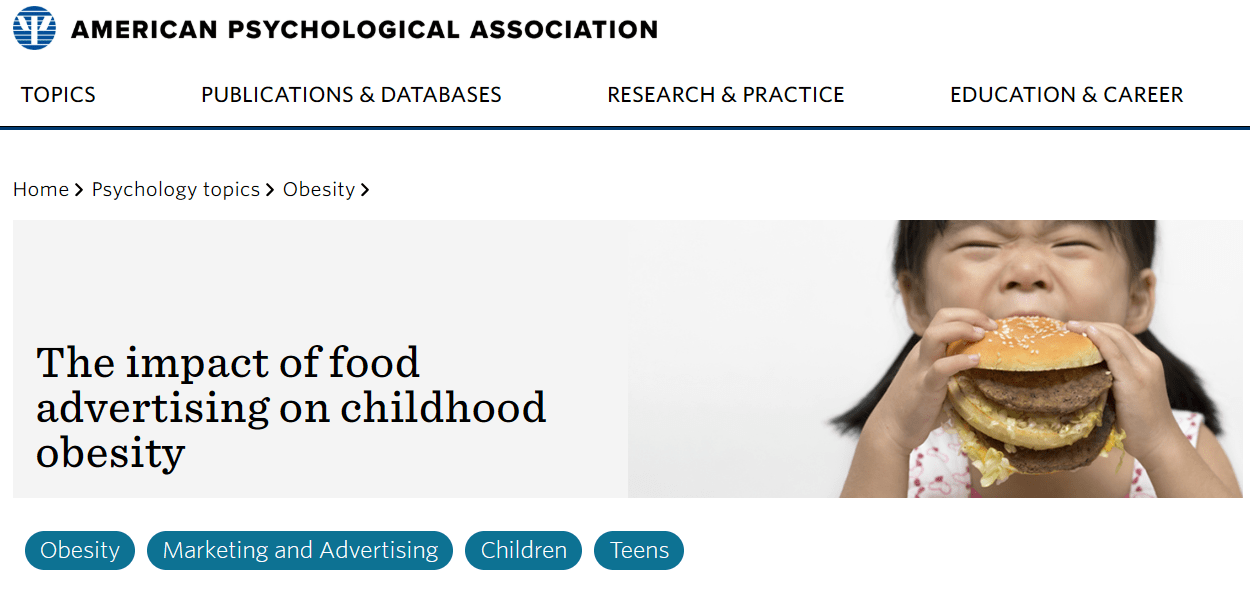
A comprehensive report by the American Psychological Association shows that over half of ads on children’s programming promote unhealthy foods (e.g., candy, cereal, fast food), often with no critical media literacy safeguards. Worse, these ads increasingly appear in the form of advergames, YouTube influencer videos, and viral content that blurs the line between entertainment and solicitation. Even schools are not immune: advertisers now enter classrooms via sponsored materials and exclusive vending contracts.[16]
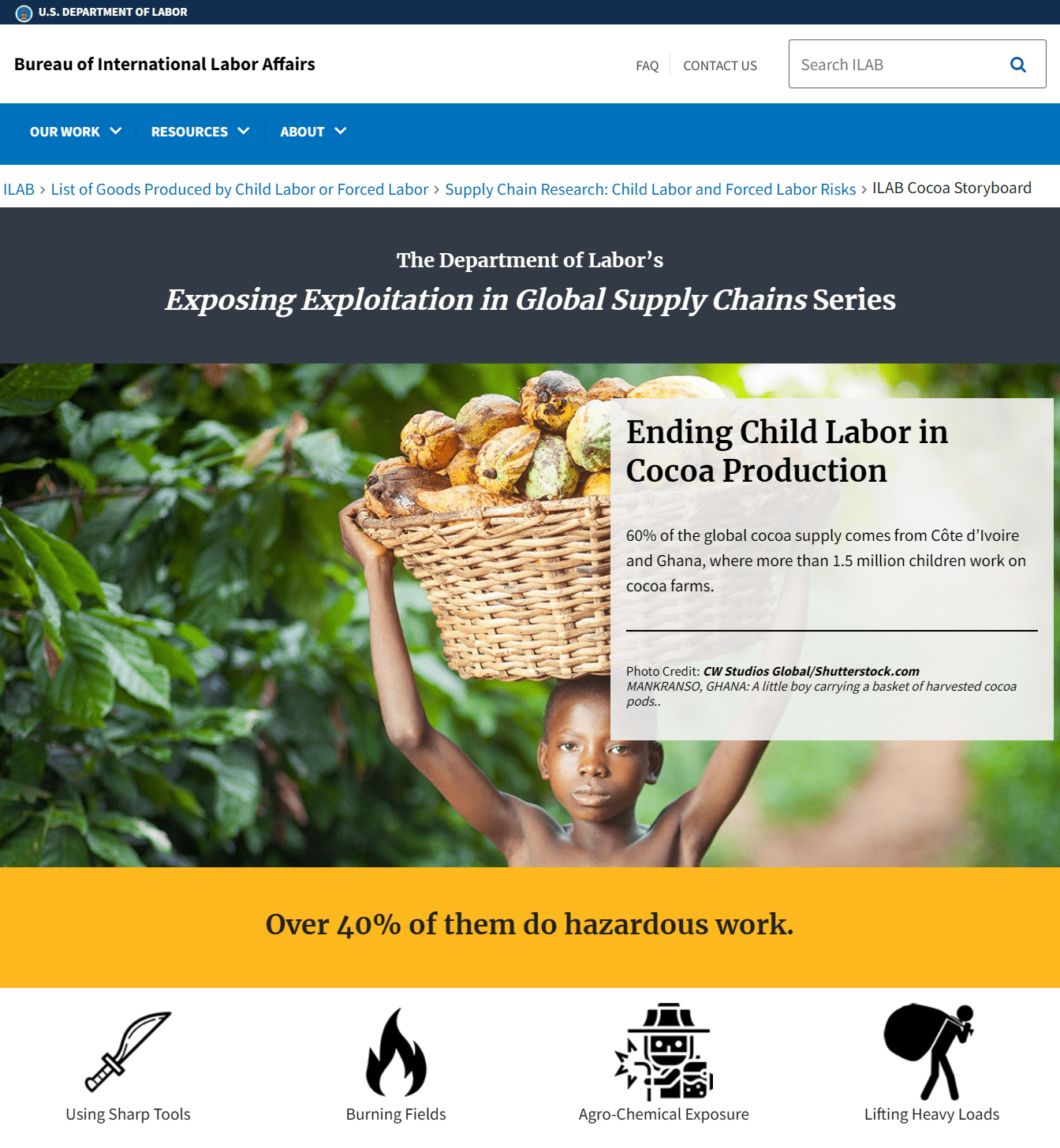
Beyond harmful consumption, children are also exploited along the production chain. Since 2009, the U.S. Department of Labor has flagged global cocoa production as high-risk for child labor and slavery, particularly in West Africa. Much of this exploitation is driven by the expanding cocoa processing operations of multinational food corporations based in the U.S. and Western Europe.[17]
Consequently, whether it’s in front of a screen or at the base of a supply chain, vulnerable populations such as children are routinely positioned not only as target audience of advertising, but also as its sacrificial victims within the broader transnational economy of over-consumption.
Computational Rhetoric of Hyper-Personalization
Finally, the rise of digital advertising in the 21st century has redefined what advertising is by transforming how ads are generated, circulated, consumed, and modulated. This transformation has been propelled by several key technological breakthroughs:
Machine learning algorithms capable of pattern recognition across massive data setsPredictive analytics that anticipate consumer behaviorReal-time bidding systems for ad placementAnd most recently, the rise of generative AI models capable of producing vast quantities of media content on demand.
Before we unpack this algorithmic pipeline, a methodological note: the technical machinery behind modern ad delivery often feels like a black box system. Proprietary algorithms, inaccessible data streams, and closed feedback loops make it difficult for everyday users to grasp how these messages are generated and optimized. In this course, where digital literacy is a central pedagogical focus, we will render this apparatus intelligible by articulating its computational rhetoric: a paradigm in which rhetorical invention is no longer at the helm of human agents alone, but programmed, synthesized, tested, and optimized through automated systems.[18]
Together, these innovations have enabled a shift toward hyper-personalization: the ability to tailor advertising not just to broad demographic segments, but to the evolving senses and sensibilities of individual users across platforms and temporal states.[19] Whether you're watching a streaming video, scrolling through short-form content, or browsing an e-commerce site, you are continuously presented with ads that adapt to your behavior, preferences, and context in real time.[20]

This brings us to a case study of an emerging advertising practice known as Dynamic Creative Optimization, or DCO, a process where ad content is generated, tested, and refined through a feedback loop of machine learning and user interaction.[21]
We begin with the exigence, by asking what material needs would necessitate computational advertising as appropriate means to fulfill? When the target audience is hidden in a fragmented, attention-scarce media ecosystem, advertisers must persuade individualized users across diverse platforms, at speed, and at scale. The rhetorical purpose, then, becomes how to optimize attention capture and behavioral influence through automated means, in order to produce the most desired audience response to the underlying advertising needs.[22]
This exigence sets the scene, a datafied lifeworld that frames what actions are possible for a computational rhetorical response, an automated cycle in which symbolic appeals are generated, tested, and refined by machines rather than by human rhetors alone. [23]
Let’s walk through this automated DCO cycle step by step: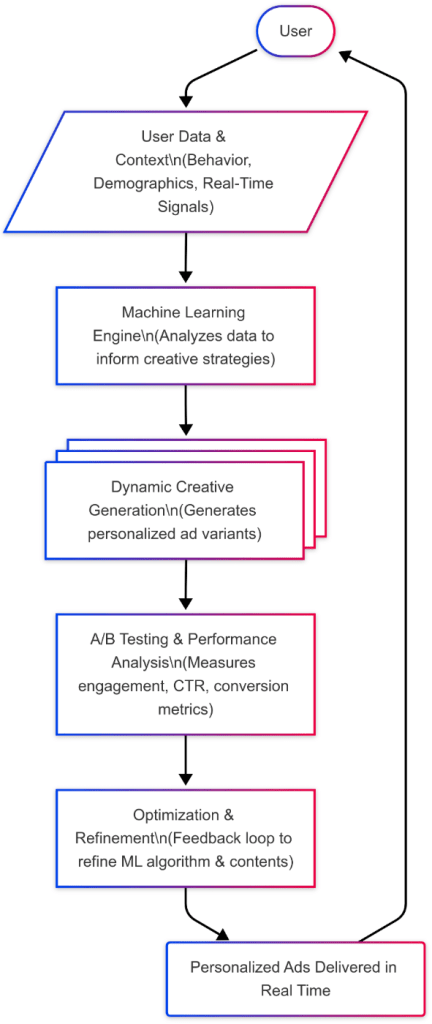
Data trail and audience modeling - The cycle begins with a user’s data trail, which includes behavior, location, demographics, search history, and contextual signals such as device and time of day. Rhetorical agents in this stage are platforms and data brokers. Their agency consists of trackers and SDKs. And the purpose for this step is predictive insight.[24]Situational analysis by machine learning - This data feeds models that analyze the rhetorical situation: Who is the user, what constraints are salient, and which appeals (e.g., logical, emotional, stylistic, sensorial) are likely to succeed?[25] The ML model then fulfills its purpose of forecasted receptivity at this stage through automated acts of segmentation and inference.[26]Generating content variants - With user insights in hand, the system selects user-adapted visuals, tones, narratives, and styles, then generates multiple tailored ad variants for testing. Generative models can serve as automated agents to fabricate, copy, and layout content at scale. The purpose for this step is identification – to achieve a measure of connection (consubstantiality) with the target user's values, beliefs, and interests.[27]Live testing and performance measurement - Content variants are deployed for real time A/B testing. Metrics such as click‑through rate, view duration, and even user conversion and eye-movements are collected and compared. The rhetorical act for this step is real time automated messaging trials within a live scene of platforms and feeds. The networked testing infrastructure and auction systems provides the rhetorical agency. The purpose for this stage is automated evidentiary calibration, and the scene–purpose ratio shows how the platform environment channels which outcomes are legible and valuable.[28]Feedback, learning, and refinement - Testing data then flows back into the system. Both the message and the model are tuned through iterative rehearsal and user optimization. The rhetorical act in this step is recalibration through the means (agency) of its optimization algorithms, in order to fulfill the purpose of improved fit.[29]Targeted delivery at the moment of engagement - The best‑performing content is then served in real time to tailor the user’s sensibilities at the present moment, maximizing user's emotional resonance and behavioral response to the advertisement. The rhetorical act here is finely timed content delivery within a dynamic scene. Ad servers and recommendation engines act as agents, delivering ads in real-time for the purpose of steering users to purchase, sign‑up, or share.[30]
In this sense, computational systems do more than execute a content strategy. DCO represents a fully automated staged drama of motives in which algorithmic rituals, tools, settings, and advertisers' aims co‑determine the persuasive act in real-time, with minimum human intervention.[31]
[1] Wang, Keren. “Legal and Ritological Dynamics of Personalized ‘Pillars of Shame’ in Chinese Social Credit System Construction.” China Review 24, no. 3 (2024): 179–206. https://www.jstor.org/stable/48788933.
[2] McDonald, Colin, and Jane Scott. "A brief history of advertising." The Sage handbook of advertising (2007): 17-34.
[3] Millstein, Ira M. "The Federal Trade Commission and False Advertising." Columbia Law Review 64, no. 3 (1964): 439-499.
[4] Jewell, Robert D., and Christina Saenger. "Associative and dissociative comparative advertising strategies in broadening brand positioning." Journal of Business Research 67, no. 7 (2014): 1559-1566.
[5] Barthes, Roland. "Myth today." In Ideology, pp. 162-172. Routledge, 2014.
[6] Pechmann, Cornelia, and Srinivasan Ratneshwar. "The use of comparative advertising for brand positioning: Association versus differentiation." Journal of Consumer Research 18, no. 2 (1991): 145-160.
[7] Wang, Keren. Legal and rhetorical foundations of economic globalization: An atlas of ritual sacrifice in late-capitalism - "Interdisciplinary historical overview." Routledge, 2019. https://doi.org/10.4324/9780429198687
[8] Bernheim, B. Douglas. "A theory of conformity." Journal of political Economy 102, no. 5 (1994): 841-877. See also, Hess, Aaron. "You Are What You Compute (and What is Computed For You): Considerations of Digital Rhetorical Identification." Journal of Contemporary Rhetoric 4 (2014).
[9] Minot, Walter S. "A rhetorical view of fallacies: Ad hominem and ad populum." Rhetoric Society Quarterly 11, no. 4 (1981): 222-235.
[10] Lim, Hayoung Sally, Lindsay Bouchacourt, and Natalie Brown‐Devlin. "Nonprofit organization advertising on social media: The role of personality, advertising appeals, and bandwagon effects." Journal of Consumer Behaviour 20, no. 4 (2021): 849-861.
[11] Farnsworth, Stephen J., and S. Robert Lichter. "No small-town poll: Public attention to network coverage of the 1992 New Hampshire primary." Harvard International Journal of Press/Politics 4, no. 3 (1999): 51-61.
[12] "1983 Apple Keynote: The "1984" Ad Introduction". YouTube. April 1, 2006. Archived from the original on June 18, 2006. Retrieved January 22, 2014.
[13] Smith, William A. "Social marketing: an overview of approach and effects." Injury prevention 12, no. suppl 1 (2006): i38-i43.
[14] Shepardson, David. "Hershey, Nestle, Cargill Win Dismissal of U.S. Child Slavery Lawsuit." Reuters, June 28, 2022. https://www.reuters.com/business/hershey-nestle-cargill-win-dismissal-us-child-slavery-lawsuit-2022-06-28/
[15] Environmental Investigation Agency. "IKEA’s Romanian Wood Sourcing Woes Highlight the Need for National Transparent Timber Traceability Systems across Europe." Environmental Investigation Agency, March 23, 2023. https://eia.org/blog/ikeas-romanian-wood-sourcing-woes-highlight-the-need-for-national-transparent-timber-traceability-systems-across-europe/
[16] American Psychological Association. Food Advertising and Children. Accessed September 28, 2025. https://www.apa.org/topics/obesity/food-advertising-children.
[17] U.S. Department of Labor. Cocoa: Supply Chains. Bureau of International Labor Affairs. Accessed September 28, 2025. https://www.dol.gov/agencies/ilab/reports/child-labor/list-of-goods/supply-chains/cocoa
[18] Richter, Jacob D. "Network-emergent rhetorical invention." Computers and Composition 67 (2023): 102758.
[19] Jain, Geetika, Justin Paul, and Archana Shrivastava. "Hyper-personalization, co-creation, digital clienteling and transformation." Journal of Business Research 124 (2021): 12-23.
[20] Micu, A., Capatina, A., Cristea, D.S., Munteanu, D., Micu, A.E. and Sarpe, D.A., 2022. Assessing an on-site customer profiling and hyper-personalization system prototype based on a deep learning approach. Technological Forecasting and Social Change, 174, p.121289.
[21] Baardman, Lennart, Elaheh Fata, Abhishek Pani, and Georgia Perakis. "Dynamic creative optimization in online display advertising." Available at SSRN 3863663 (2021).
[22] Roderick, Noah. "Exigence at the dawn of recommendation media: Dramatizing salience in audio memes." Rhetoric Society Quarterly 54, no. 1 (2024): 74-88.
[23] Landes, David. "Kenneth Burke’s Theory of Attention: Homo Symbolicus’ Experiential Poetics." KB Journal: The Journal of the Kenneth Burke Society 16, no. 1 (2023).
[24] Rhetorical agents in this stage are platforms and data brokers. Their agency consists of trackers and SDKs. And the purpose for this step is predictive insight. The scene–act ratio for this initial stage shows how a data‑saturated scene constrains subsequent acts of user-optimized content creation.
[25] Acree, Brice. "Deep learning and ideological rhetoric." (2016). https://cdr.lib.unc.edu/concern/dissertations/s1784m14f
[26] The system's machine learning architecture and feature engineering constitute the means (rhetorical agency) by which user analysis occurs.
[27] Kraus, Mathias, and Stefan Feuerriegel. "Sentiment analysis based on rhetorical structure theory: Learning deep neural networks from discourse trees." Expert Systems with Applications 118 (2019): 65-79.
[28] The rhetorical act for this step is real time A/B testing, automated messaging trials within a live scene of platforms and feeds. The networked testing infrastructure and auction systems provides the rhetorical agency. The purpose for this stage is automated evidentiary calibration, and the scene–purpose ratio shows how the platform environment channels which outcomes are legible and valuable.
[29] Here, the Burkean terministic screens are decisive: metrics select what user feedback counts as "success," which then directs future optimization. The agency–purpose ratio reveals how optimization instruments and dashboards steer advertisers' objectives.
[30] The rhetorical act here is finely timed content delivery within a dynamic scene. Ad servers and recommendation engines act as agents, delivering ads in real-time for the purpose of steering users to purchase, sign‑up, or share. Identification culminates in internalized alignment between the advertisement and the view, forming a temporary consubstantiality that completes the dramatistic arc of DCO .
[31] Coleman, Miles C. Influential machines: the rhetoric of computational performance. Univ of South Carolina Press, 2023.