Posted by Keren Wang, FA 2025

1) Public Relations and Propaganda
Let’s start today’s discussion with one of the most famous political ads in American history: Lyndon B. Johnson’s 1964 “Daisy” ad. It’s only about a minute long, but it changed the entire landscape of political persuasion. Go ahead and give it a watch: LBJ campaign’s “Daisy” ad (1964).
What you’ll notice is that it doesn’t actually make a direct campaign argument. Instead, it relies on a carefully orchestrated mix of sensory cues—sound effects, imagery, lighting, and camera movement—to evoke fear, innocence, and the looming threat of nuclear apocalypse. This is the language of modern public relations.
To understand where this comes from, we need to go back to World War I and the work of Edward Bernays (1891 - 1995) — often regarded as "the father of public relations."
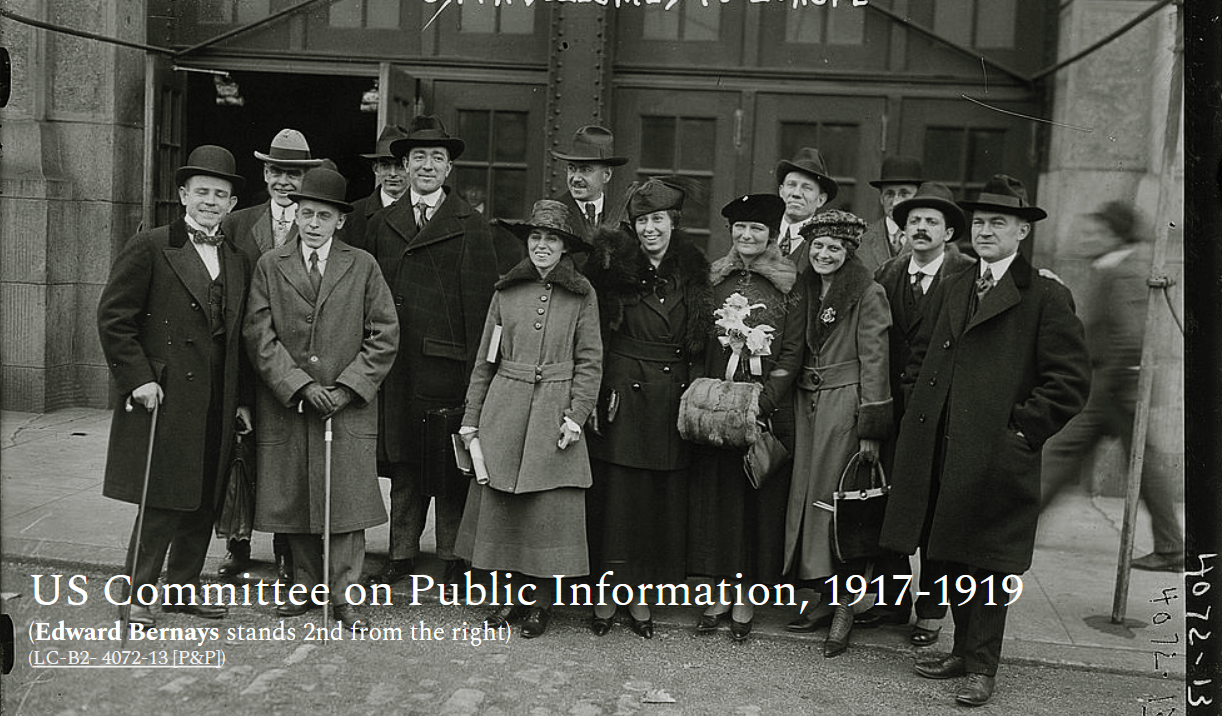
Bernays began his PR career during World War I, working for the U.S. Committee on Public Information, a federal agency established in 1917 to mobilize American public opinion in favor of entering the war. That experience taught him how coordinated messaging, emotional appeals, and media management could shape collective perception on a national scale. Drawing on those lessons, Bernays later published Propaganda (1928), Public Relations (1945), and The Engineering of Consent (1955), where he argued that the same persuasive techniques used in wartime could and should be employed in peacetime governance and business.
More importantly, Bernays did not see public relations as distinct from propaganda; rather, he considered it its modern, professionalized form. As he wrote, “The propagandist who specializes in interpreting enterprises and ideas to the public, and in interpreting the public to promulgators of new enterprises and ideas, has come to be known by the name of ‘public relations counsel.’” [Edward Bernays' Propaganda, p. 37]
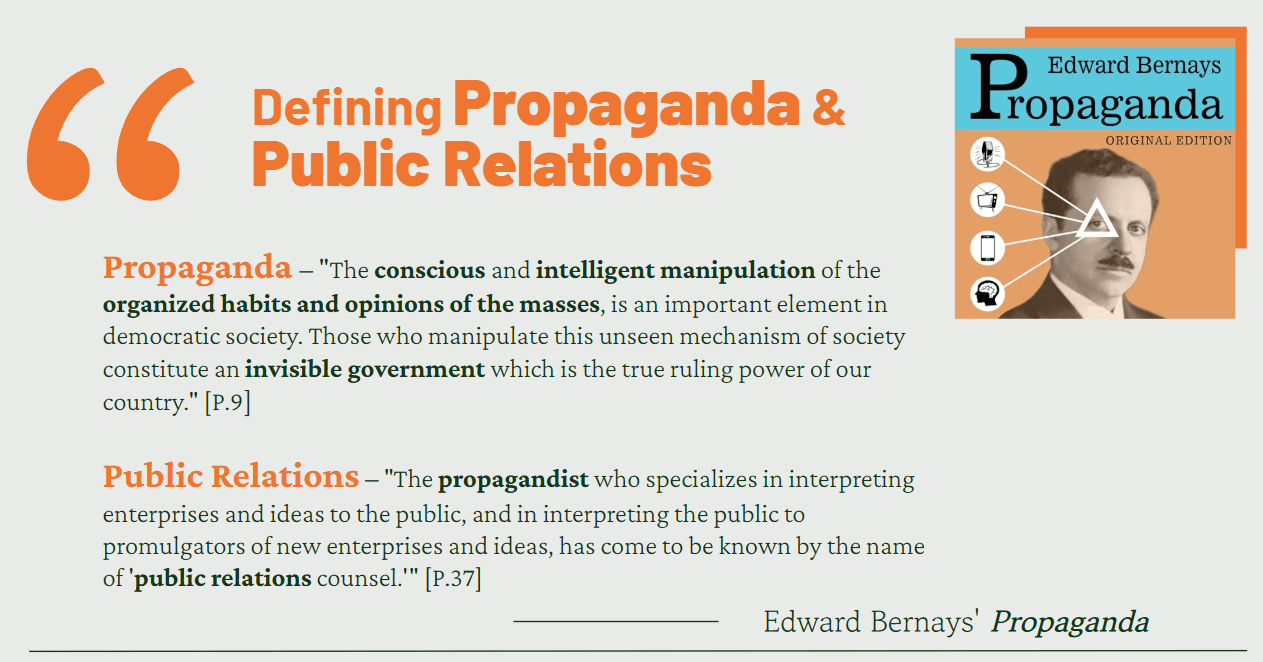 In practice, both propaganda and PR use the same persuasive techniques. They both rely on emotional cues, mass media, and message framing. The only real difference is how we justify them. PR claims to serve mutual understanding, while propaganda is framed as manipulative. However, at what point does “interpreting” the public’s interest turn into “engineering consent”? And who gains when this line blurs?
2) Inside the PR Industry
Fast‑forward a century, and public relations has become a massive industry — an invisible backbone of modern politics and corporate communication. Major PR firms can charge monthly retainers anywhere from $20,000 to $100,000 or more. A single nationwide campaign might cost tens of millions. Their client list spans everything from corporations and nonprofits to government agencies and political campaigns.
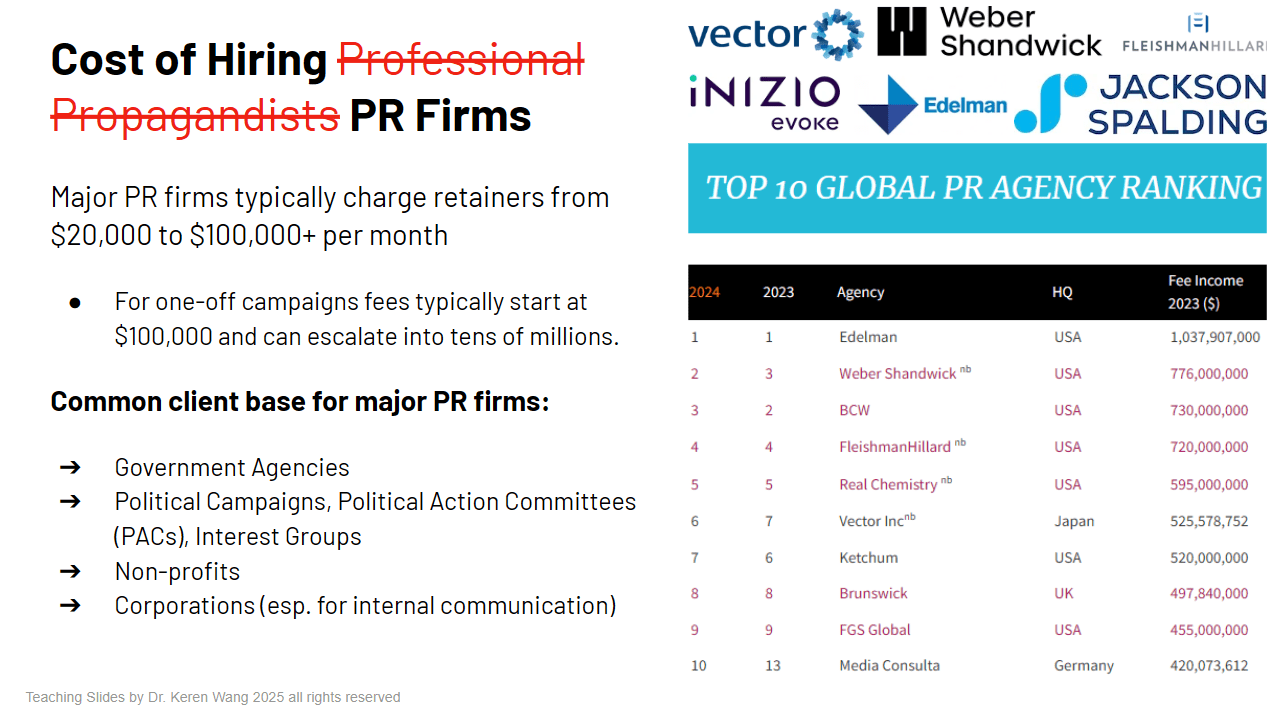
Think about election seasons. Every candidate, every PAC, and every issue‑advocacy group now hires PR consultants to manage their image and control narratives. This is where strategy and spectacle meet. In addition to crafting talking points, PR firms also orchestrate a candidate’s entire public persona, deciding how a message will land on cable news, social media, or in a town hall.
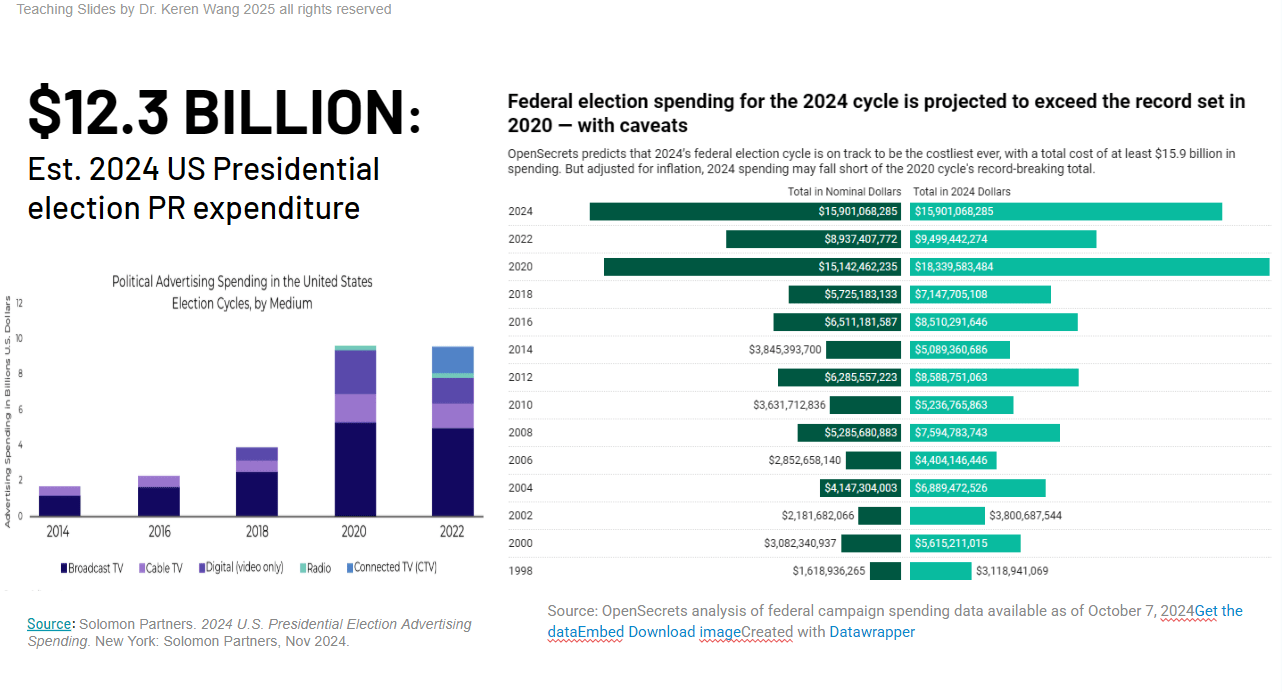
To get a real sense of how intertwined this is with our democracy, take a look at OpenSecrets.org. It’s a nonprofit that tracks lobbying expenditures and campaign finance. Their Revolving Door database shows how officials move between public service and lobbying firms, or a pipeline between government decision‑making and privatized public influence machinery.
3) Common PR Activities
Now, let’s focus on the practical applications of PR work. What does PR look like day to day? It’s not all press conferences and slick slogans. Much of it involves slow, strategic relationship‑building, and "issue management (a.k.a. the art of making problems disappear)" Let’s walk through a few core activities.
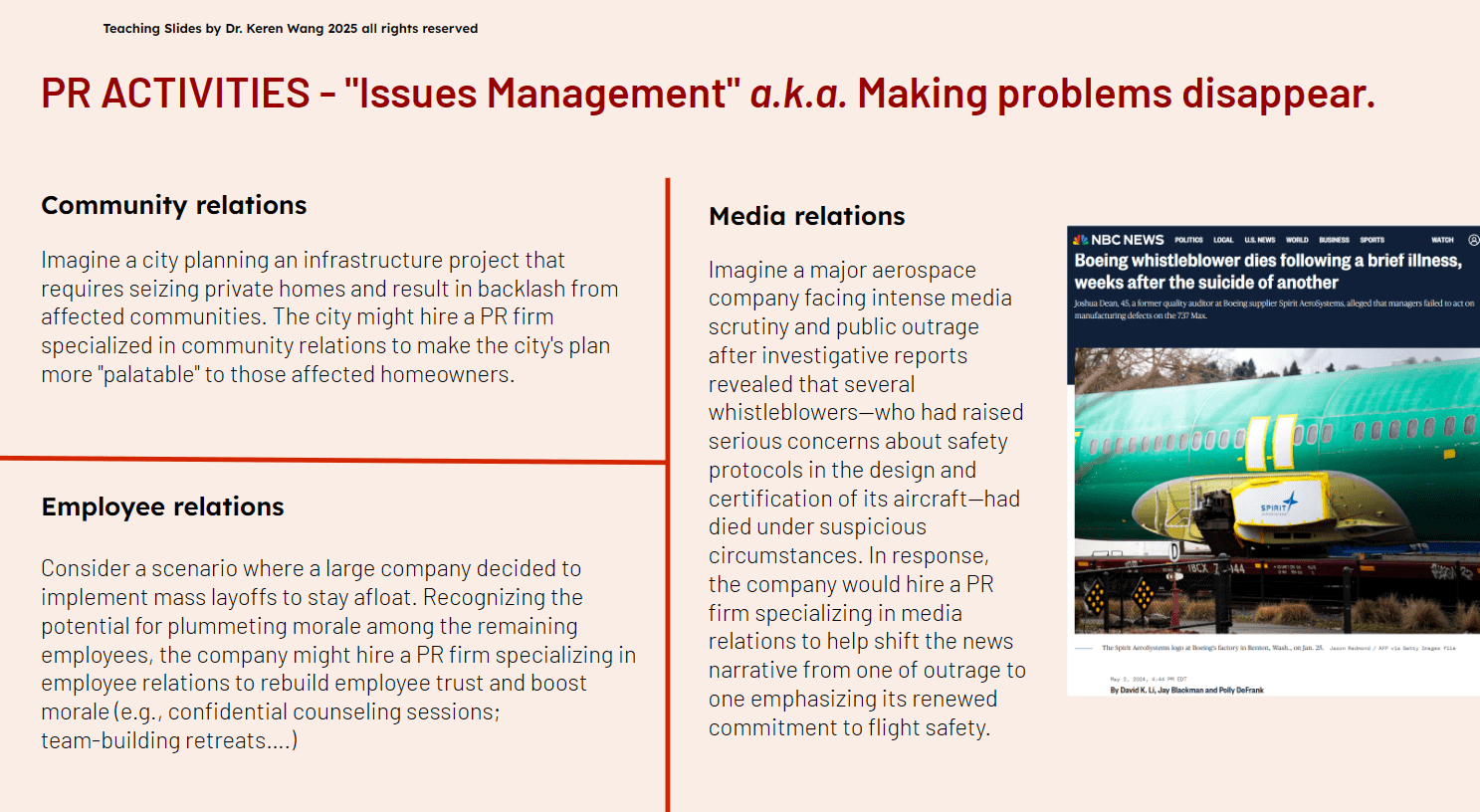
Community relations
Community relations is a common area where PR practice. The goal isn’t simply to inform the public, it’s to make resistance appear unreasonable, and to secure what’s Bernays called “engineered consent” from the targeted community.
Imagine a city trying to build a new highway through a residential area, which requires the city to seize private homes for redevelopment. The city might hire a PR firm specialized in community relations to make the city's plan more "palatable" to those affected homeowners. PR teams will hold town‑hall meetings, produce brochures, and frame the project as a win for local jobs and development.
Media relations
Media relations focuses on managing communication with journalists and news outlets, especially during times of crisis or scandal (e.g., a product recall or environmental spill). PR professionals draft statements, train spokespeople, and pitch exclusive interviews. Their goal is to redirect the story from blame toward accountability and resolution.
Imagine a scenario in which a major aerospace company faces intense media scrutiny and public outrage after investigative reports reveal that several whistleblowers—who had raised serious concerns about safety protocols in the design and certification of its aircraft—have died under suspicious circumstances. In response, the company hires a PR firm specializing in media relations to help shift the narrative from outrage to one emphasizing its renewed commitment to flight safety.Employee relations
Employee relations is about keeping morale intact within an organization. Internal newsletters, video updates, or even informal “Ask Me Anything” sessions with leadership — all of these fall under PR because they shape how insiders talk about their own institution.
Consider a scenario where a large company decided to implement mass layoffs to stay afloat. Recognizing the potential for plummeting morale among the remaining employees, the company might hire a PR firm specializing in employee relations to rebuild employee trust and boost morale (e.g., confidential counseling sessions; team-building retreats….)Government affairs
Government affairs connects private interests with public policy. It’s the PR-coded name for lobbying. PR professionals in this space draft testimony, coordinate coalition letters, and often ghostwrite talking points for lawmakers sympathetic to their cause.
To explore more on government affairs / lobbying:
Corporate Social Responsibility
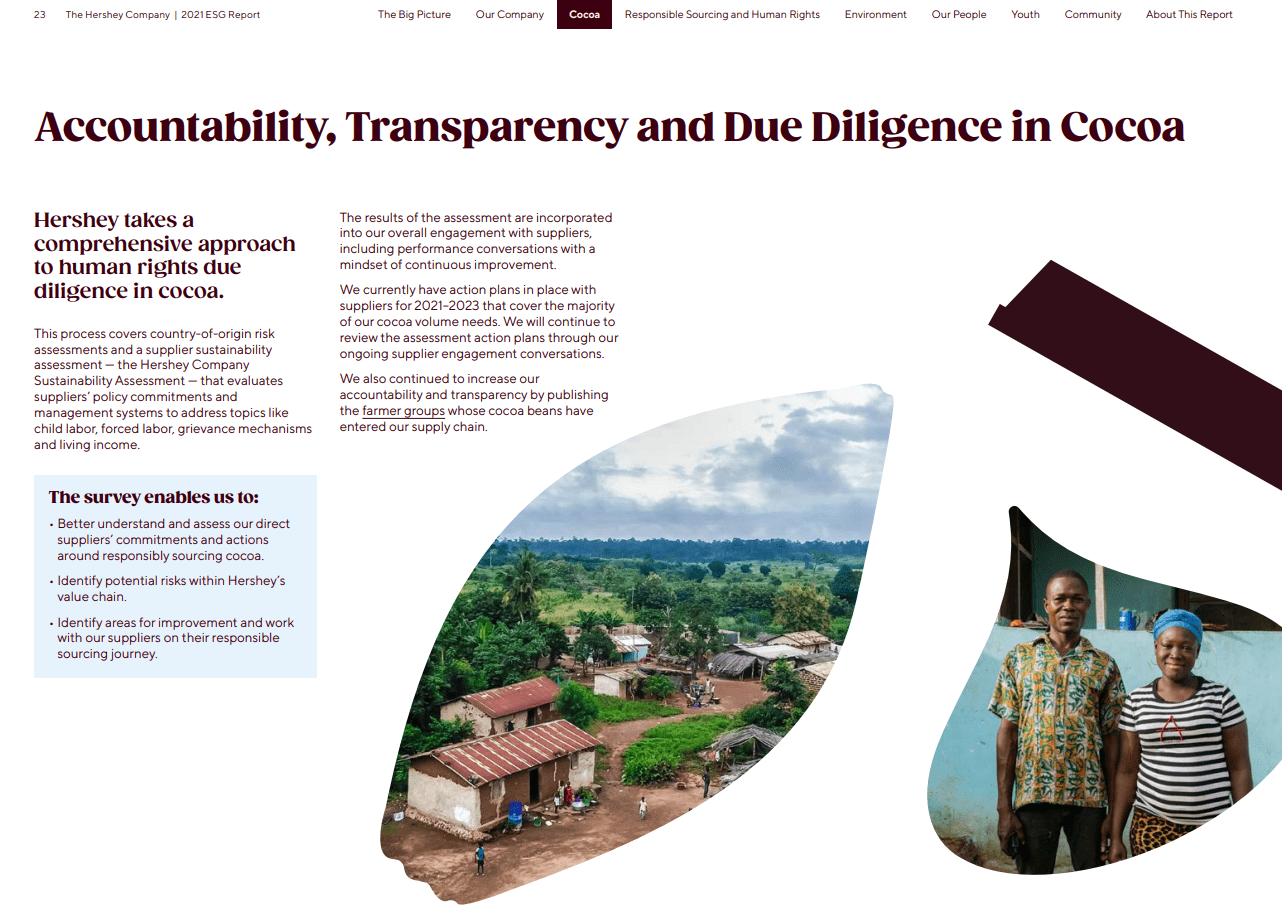
And finally, Corporate social responsibility, or CSR. This is when companies try to showcase their ethical side, often as responses to a break of public controversy. Some examples of this type of PR work can be found in the lesson "Understanding Advertising through Consumer Psychology and Computational Rhetoric" under the "Social Marketing & Exploitation" section:
An example of Corporate Social Responsibility as a PR strategy can be seen in the case of Hershey’s 2021 “Accountability, Transparency, Due Diligence” campaign, which served as a rhetorical camouflage precisely at a moment when Hershey's was under investigation for child labor violations and facing a class action lawsuit filed by former child slaves who alleged that the Pennsylvania-based company "aided and abetted their enslavement on cocoa plantations in Ivory Coast."[14]
 Many critics point to the “Climate Change Collection” shown below as an example of IKEA’s social marketing campaigns to “greenwash” the company’s well-documented history of selling furniture made from illegally logged wood.[15]

4) PR and Disinformation
Of course, the same toolkit that can inform and persuade can also deceive. This is where public relations crosses into what critics call disinformation. Let’s unpack a few common tactics:
Spin - this is the most familiar. It’s when communicators flood the airwaves with half‑truths or unrelated talking points to distract from scrutiny. You’ll see plenty of spin PR tactics deployed in political press briefings, corporate statements, and social media campaigns.
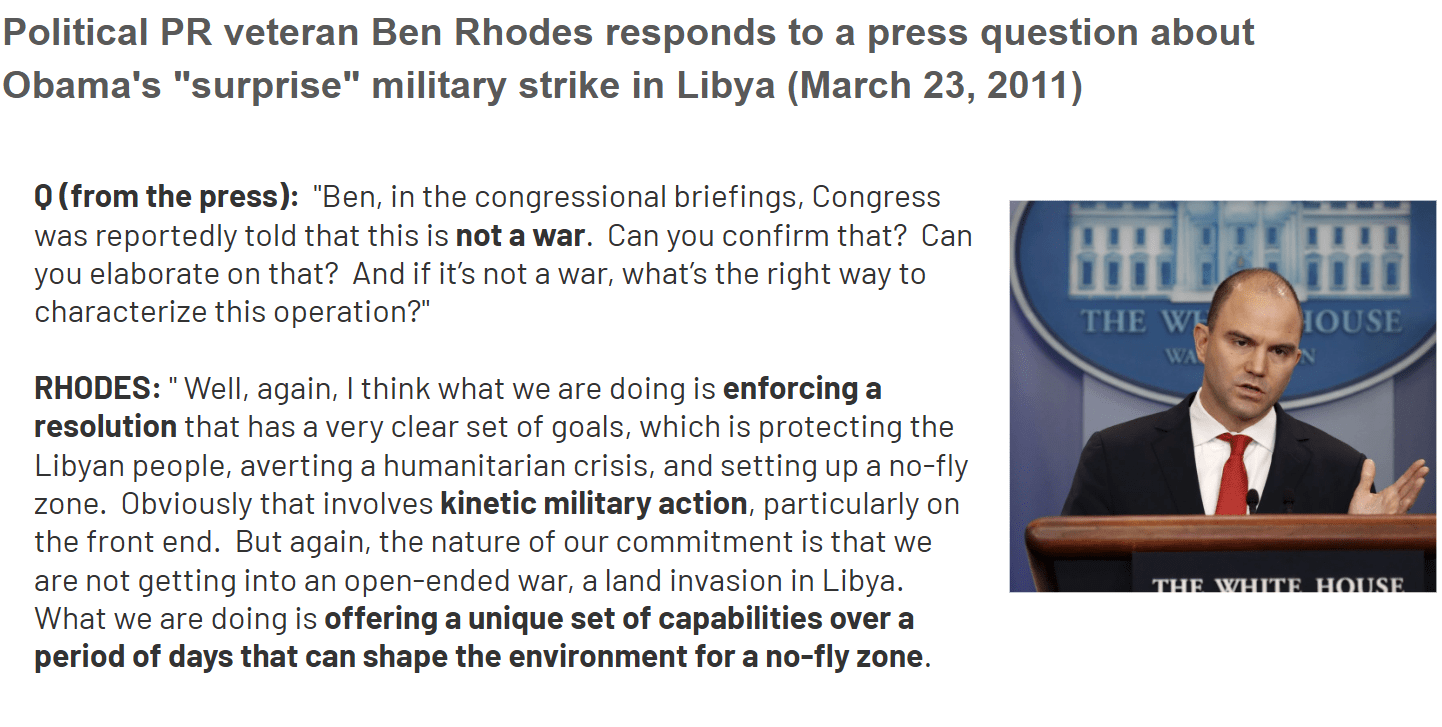
Source: The White House. Press Briefing by Principal Deputy Press Secretary Eric Schultz and Deputy National Security Advisor for Strategic Communications Ben Rhodes. August 13, 2014. Obama White House Archives.
Astroturfing: creating fake grassroots movement & public opinion. With increasingly sophisticated ✽dynamic creative optimization tools, ✽deepfake generators, and ✽bot farms, astroturfing campaigns can mimic genuine public opinion at scale, making it harder to distinguish between authentic and manufactured sentiment.
“Energy Citizens” rallies (2009) reportedly organized by the American Petroleum Institute to project constituent pressure during the climate bill debate. See press coverage and leaked memos for the logistics and intent.Working Families for Wal‑Mart (2005–2006) created with Edelman as a pro‑Wal‑Mart advocacy effort that drew criticism for masking sponsorship on blogs.
Mercenary science - Paid research or ghostwritten analyses that borrow scientific form to create doubt about risk. The tobacco industry’s “doubt is our product” memorandum is the canonical case for understanding how controversy is manufactured.
Pseudo‑event - Staged spectacles designed to be reported as news. A well‑known example is the 2003 “Mission Accomplished” carrier speech, which offered a powerful image even as the underlying conflict continued.
5) Democratizing PR?
We’ll end on a more optimistic note. The same digital tools that supercharge disinformation can also empower citizens. The proliferation of affordable AI, online transparency portals, and open data (published and managed under open source / open access principles) have made it possible for ordinary people to access powerful PR toolkits with little cost, and to trace how influence works. Platforms like OpenSecrets lets users see who’s funding whom, what lobbyists are working on which issues, and where former government officials now draw a paycheck.
This new democratic potential of "open source PR" can be understood as public relations in reverse, where citizens as users managing transparency and public accountability.
In closing, rather than viewing PR as purely manipulative, we might increasingly see it as a contested terrain where persuasion, power, and accountability constantly collide. If we can read PR critically, we can also mobilize its techniques and technology for democratic engagement, activism, and social change.