The phrase 养龙虾 entered the lexicon of early 2026 not as a figure for aquaculture but as a mode of human-machine relation: the deployment, configuration, and ongoing cultivation of OpenClaw, an open-source agentic AI tool whose iconography features a red cartoon lobster and whose distinguishing feature, relative to the chat-style models that preceded it, is the closure of task loops with minimal supervisory input. The verb 养, which spans the husbandry of livestock, the keeping of pets, and the rearing of children, performs analytical work that English equivalents (deploy, host, configure, run) cannot. What it makes visible — and the visibility is itself the philological event, not my imposition on it — is that the tool’s relation to its operator has been recoded from instrumental use to ritualized custodianship.
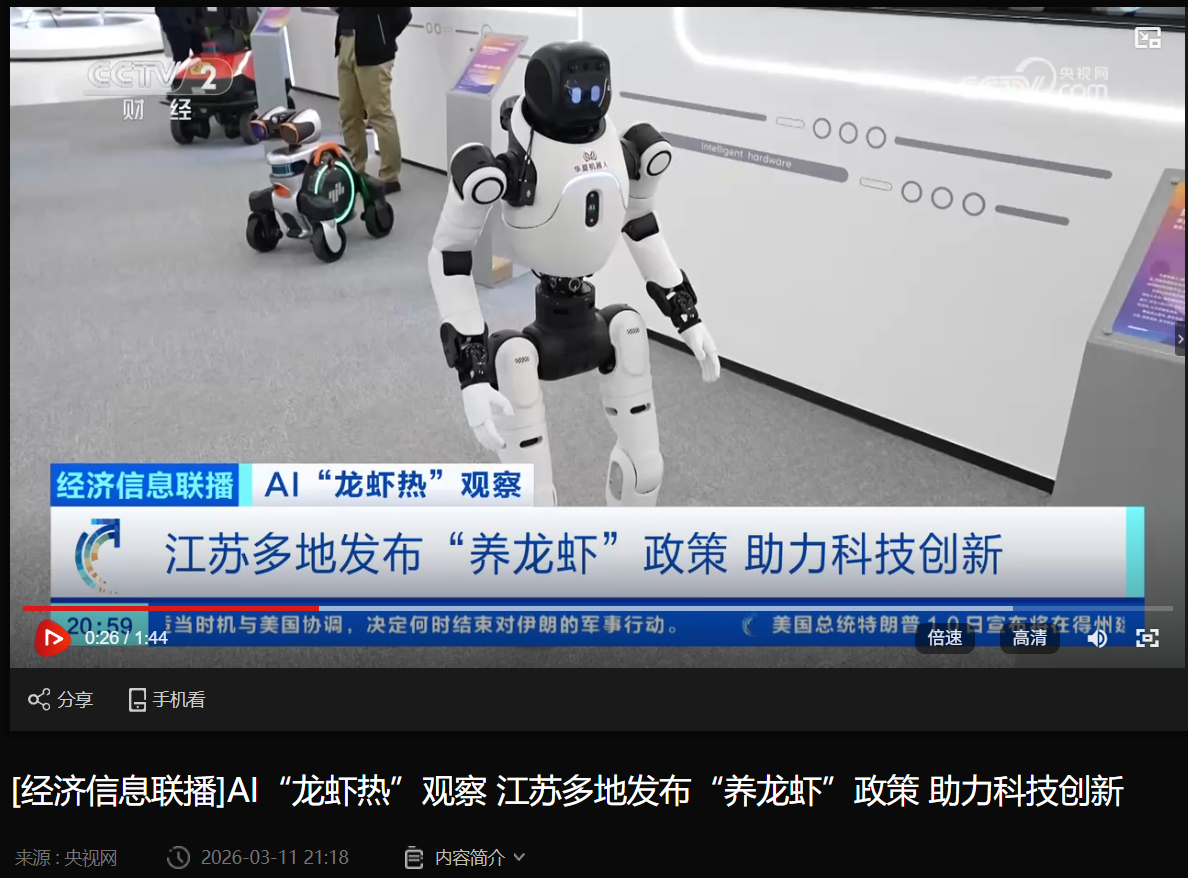 CCTV-2 财经, 经济信息联播, 11 March 2026. Chyron: 江苏多地发布"养龙虾"政策 助力科技创新 (“Multiple Jiangsu localities announce lobster-raising policies in support of technological innovation”). The humanoid in foreground is from Huaxia Robotics (华夏机器人).
The empirical surface of the episode is by now adequately documented in Chinese-language coverage. From a baseline reading of zero on January 29, OpenClaw’s WeChat Index climbed past 165 million by March 10. By early March, the GitHub repository had crossed 230,000 stars and the project claimed more than a million independent deployment instances globally. The most photographed moment was the queue at Tencent’s Shenzhen tower on March 6, where company engineers ran a free public installation clinic for several hundred developers and enthusiasts. Within seventy-two hours of that scene, the Shenzhen Longgang District released its so-called Ten Lobster Measures, a subsidy package targeting OPC (one-person company) founders willing to deploy agent-based businesses; Wuxi’s High-Tech Zone followed within forty-eight hours with twelve support measures including grants of up to five million RMB; Hefei, Suzhou, and Changshu issued parallel programs over the following days. By mid-March, A-share markets had designated 419 listed firms as AI-agent concept stocks, and Goldman Sachs Asia sales had circulated a client memorandum titled Train your own “Lobsters,” inviting global investors to read the phenomenon as macro signal rather than local oddity.
The compression of empirical adoption, viral discourse, local subsidy texts, capital market response, and international financial framing into a single fortnight is the first feature that warrants notice. It exemplifies, with unusual clarity, what Foucault would have recognized as governmentality operating through the conduct of conduct rather than through prohibition: subsidy regimes do not order anyone to raise lobsters, but they channel the trajectory of grassroots enthusiasm into officially legible economic forms. The 2026 Government Work Report’s introduction of “intelligent economy as new form” language, almost simultaneous with the viral peak, completes the loop. What in another political-economic configuration might have unfolded as three sequential phases (bottom-up enthusiasm, market response, regulatory tightening) here folds into overlapping motion.
The metaphorics of 养 deserve a closer reading. The verb does not denote a single relation: it spans 养鸡 (raising chickens for slaughter), 养狗 (keeping a dog as companion), 养孩子 (rearing a child), and 养花 (cultivating flowers for aesthetic pleasure). What unifies these usages is a protocol of continuous provisioning toward a being whose growth is contingent on the carer’s regular attention. The carer feeds; the cared-for changes over time in ways the carer monitors. When this protocol is transposed to OpenClaw, the substrate of provisioning shifts from rice and water to tokens and permissions. Users feed Tokens (the linguistic units consumed by the language models the agent calls) and grant successively expanded administrative privileges, beginning with directory access and culminating in command-line execution and API authentication, as trust accrues over time. The agent in turn accumulates persistent memory of user preferences and behavioral patterns, becoming what Chinese commentary describes as 越用越懂用户, increasingly attuned to the operator the longer it operates.
This is, in Burkean terms, a terministic screen with sharp selection effects. By naming the relation 养, the discourse renders certain features of the human-agent dyad sharply visible: continuity, attentiveness, asymmetric care, the agent’s proto-organic capacity for growth. It simultaneously occludes others: the corporate provenance of the underlying language model whose tokens the user purchases, the security perimeter that the granting of administrative privilege actually breaches, the recursive labor of furnishing training-data-by-use to the model’s developers. To raise the lobster is to perform a private domestic ritual whose costs and risks are externalized onto infrastructures that the metaphor itself helps render unthematized.
The sacrificial economy here is worth registering without overstatement. Token feeding is not literal oblation, but it occupies a structural position that students of Mauss and Girard will recognize. The user gives — money, attention, permissions, the cumulative data trail of every interaction — and receives back capacities (task completion, automation, the felt sensation of being multiplied). The exchange is asymmetric and continuous rather than reciprocal and discrete; the giver cannot easily disengage without losing the cumulative attunement that the giving has built up. Coverage in the Chinese tech press has begun to register this asymmetry through the new vocabulary of trajectory data: every click, error, and revision performed by the agent on behalf of the user is logged as a behavioral path far more valuable than any textual output. The lobster is fed, but it is also feeding.
The international asymmetry is more interesting than the available cultural-essentialist accounts allow. Western adoption of OpenClaw has remained largely confined to developer circles, and Chinese commentary has crystallized around two narrative frames that are themselves rhetorical artifacts of the moment. The first attributes Western caution to a generational sensorium shaped by Terminator and The Matrix, encoding machine autonomy as existential threat. The second attributes Chinese embrace to a generational sensorium shaped by post-1978 industrialization, in which new technology is identified prereflectively with material improvement. Whatever one makes of these as causal accounts of differential adoption, what they accomplish discursively is the genuinely interesting move: they convert a market-structural divergence (Chinese platforms have synchronously integrated OpenClaw into WeChat, DingTalk, Feishu, and Taobao at the deployment-pipeline level, while Western platforms have not) into a cultural-essentialist story that legitimates state-coordinated rollout as the natural expression of a national disposition.
The most analytically rewarding countercurrent is the security advisory issued by the Central Cyberspace Affairs Commission’s Data and Technology Support Center in mid-March. The advisory’s notable feature is not its catalogue of vulnerabilities (prompt injection, the so-called ClawJacked remote-control flaw, hallucination-driven destructive operations) but its observation that domestic enthusiasm for OpenClaw substantially exceeds global enthusiasm in a manner that “departs from the technical substance” and may mislead users into investing time in pseudo-concepts. That sentence, issued by a state organ in the middle of a state-coordinated rollout, is a rare moment of internal self-correction. It admits, with characteristic indirection, that the domestic boom is being inflated by discursive feedback loops rather than by the underlying technical advance. To register this admission in the same fortnight as the local subsidy programs is to glimpse the polycentric character of Chinese technology governance with unusual clarity. Different organs of the state are not merely uncoordinated; they are performing distinct rhetorical functions for distinct audiences, with the resulting equilibrium reading less like incoherence than like distributed risk management.
A closing observation, which returns to the metaphor. The four mythological figures I have been working with elsewhere (the Golem, Talos, the Homunculus, and Yan Shi’s automaton from the Liezi) share a feature: they are made, and their makers reckon, in different idioms, with the consequences of having made them. The lobster differs interestingly. It is not made; it is raised. Its alterity is preemptively domesticated by the cuteness register, by the borrowed vocabulary of pet ownership, by the metonymic distance between “a lobster” and “an autonomous system holding administrative access to one’s file system.” This is a different mytho-political configuration from the ones Western anxieties about AI typically produce. It is closer to the ritual-instrumentalism of 養, the Confucian-inflected protocol by which sustained provisioning yields moral relation, than to the Promethean idiom of fabrication. Whether such a protocol scales, whether one can in fact stand in a relation of 養 to a system whose fundamental grammar is corporate, infrastructural, and trans-jurisdictional, is the question the spring of 2026 has put on the table without yet answering.